
Told through the eyes of Rozaq, a poor fisherman whose intellectual disability places him at a greater disadvantage socially, Fish, Please! Takes place over the course of one day and night showing how just 24 hours can drastically change the lives of those trying to eke out an existence below the poverty line and visibility of those with the power to help, but turn a blind eye.
Instead of happily looking forward to welcoming their soon to arrive baby, Sasa and Rozaq are forced to face the terrifying reality that the constant pain wracking her body are signs of malnutrition. When they’re told by the local midwife that Sasa has severe protein deficiency due to having no access to meat and fish, the couple is warned that either they get to a hospital, or find a way for Sasa to boost her nutritional intake as soon as possible, lest she and the baby both die.
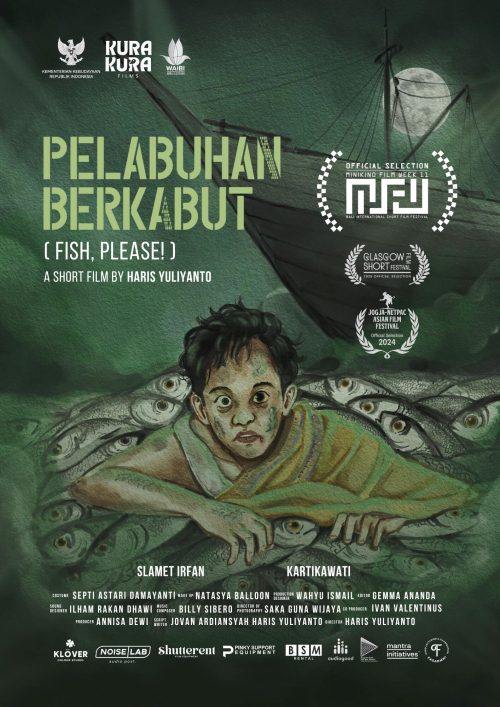
With no money or method to get to a city hospital, Rozaq with his singleminded focus determines that finding fish, even just one, will cure his beloved wife. He promises her and their unborn son that he’ll be back with fish, and begins a stressful journey through the village to the nearest fish market, where late at night he spots a shipment of freshly caught fish being offloaded. But there’s yet another major obstacle, this time in the presence of armed guards working for the local ganglord.
Though Rozaq may not have the same intellectual capabilities of others, he’s not without his own form of resourcefulness. With his thin, sweat covered frame covered in an oversized tank top, shorts that have seen better days, and sandals, Rozaq fits in with the group of other poor men hired to offload the shipment. Once inside, he realises that what’s happening in the warehouse is nothing like the locals think it is.
Sitting on the bare concrete and freezing air, Rozaq finds men for his village and surrounding areas, in strange physical states almost too disorienting to fully comprehend, because some of them look almost inhuman. After successfully stealing one fish and hiding it in his yellow cotton scarf, he seeks to make his desperate escape, but suddenly a thick bright green mist begins to fill the space, and as he utters “Ikan” meaning fish – the word he’s been constantly repeating to himself as a reminder of his goal – Rozaq falls unconscious.
Upon waking up, he finds the other men around him laying still on the cold floor. Whether dead or unconscious, Rozaq doesn’t seek to find out. Just as he left him with one purpose, he makes his way back repeating “ikan” over and over to himself. But unbeknownst to Rozaq, his face and body have changed. His brown suntanned skin is now a sickly silver, with raised welts eerily similar to fish scales covering parts of his face down to his chest and arms. Once he makes it home the transformation is complete, leading to a sadly disturbing end, that’s a bit too fun to fully spoil, but the phrase “You are what you eat” is rather appropriate as it not only describes what happens to Rozaq, but also serves as a reminder of how our bodies, our very survival as humans depends on the foods we have access to eat.
In Fish, Please!,Haris is using this multi-genre film that intertwines horror, noir, and magical realism conveyed through the music by Billy Sibero and cinematography by Saka Guna Wijaya, into an interesting tapestry of social commentary about the physical consequences pregnant women bear during pregnancy and the life threatening reality it is that society tends to overlook. He points to how food insecurity is a threat to the wellbeing of mothers, and creates circumstances where husbands and relatives are left with no choice to make decisions they never thought themselves capable of making in order to simply make it through another day.
Being a proud member of the Sailor Family, the community of fisher folk who for hundreds of years have made their living in the blue depths of the ocean surrounding Java, and bustling markets on land, Haris had made multiple short films about how the intersection of culture, capitalism, and politics have impacted the Sailor Families and their communities. In Pelabuhan Berkabut (Fish, Please!), he and his creative team make clear the threat of overfishing, pollution, resource hoarding by the wealthy, and lack of social and government assistance. Though the film is set in Indonesia, all of these issues pose the same serious detrimental consequences to the people of all coastal regions in Asia, the Caribbean, continental Africa, and globally.
Produced by KuraKura Films, Pelabuhan Berkabut (Fish, Please!) has received many nominations and awards at many international film festivals including Best Director at the 2026 Karachi Film Festival, Sun Bear Award and Mahligai Award at Balikpapan Film Festival 2025, and was an Official Selection at the 2025 Glasgow Short Film Festival as part of the Bali–Glasgow Filmmaker and Programme Exchange.
During Minikino, I had the opportunity to sit with Haris to discuss using film to highlight the issues affecting his community on Semarang, working with Slamet who’s also a musician, and figuring out how he, Jovan, and Saka Guna wanted the film to look and feel for audiences.
*All images courtesy of KuraKura Films
Carolyn Hinds
Freelance Film Critic, Journalist, Podcaster & YouTuber
African American Film Critics Association Member, Tomatometer-Approved Critic
Host & Producer Carolyn Talks…, and So Here’s What Happened! Podcast
Bylines at Authory.com/CarolynHinds
Twitter & Instagram: @CarrieCnh12
#PelabuhanBerkabutFishPlease #MinikinoFilmWeek11 #kcrush #kcrushinterview #KuraKuraFilms #HarisYuliyantoFilmmaker #SemarangIndonesia #kcrushamerica #kcrushmagazine #filmfestival #musicbyBillySibero #cinematographybySakaGunaWijaya #foodsweeat #ourbodiesarewhatweeat
User Review
( votes)Related Articles

Fantasia IFF 2025 – KCrush Interview with ‘Blank Canvas / Kakukaku Shikajika’ Co-writer and Artist Akiko Higashimura
Award-winning manga author and illustrator Akiko Higashimura is probably one of the very few people to pen their own autobiography, in manga form no less, have that autobiography adapted into a film, and be co-writer of the screenplay and artistic... Read More
Minikino Film Week 11 – KCrush Interview with ‘Traces of My Brother’ Creative Producer Brahmantyo Putra
“Where is the justice?” is the question that builds the foundation of filmmaker Riani Singgih’s documentary short Traces of My Brother / Dia Pergi dan Belum Kembali, which screened at the 2025 Minikino Film Week in Bali, Indonesia. On May 15,... Read More
Fantasia IFF 2025 – KCrush Interview with ‘Fragment’ Filmmaker Kim Sung-yoon
For his award-winning debut feature film Fragment (Pa-pyeon), which had its North American premiere at the 2025 Fantasia International Film Festival, writer and director Kim Sung-yoon (Kim Ji-young: Born 1982) took on the challenge of examining... Read More
Minikino Film Week 11 – KCrush Interview with ‘Water Sports’ Producer Alemberg M. Ang
Disclaimer: Some of the topics discussed would be mature and provocative in theme – the topics discussed are mature in nature. Award winning production designer, writer and director Whammy Alcazaren (Bold Eagle, Whether the Weather... Read More
Fantasia IFF 2025 – KCrush Interview with ‘I Fell In Love with a Z Grade Director in Brooklyn’ Filmmaker Kenichi Ugana and Actress Ui Mihara
Oh, to be an artist who’s lost the will to create! What trials the creative process can be when you possess more passion than you do money. In his latest film (well at the time of writing this anyway) I Fell In Love with a Z Grade Director in... Read More
Minikino Film Week 11 & KCrush Interview with Fransiska Prihadi, Matt Lloyd, and Holly Márie Parnell
From the 11th of September to the 19th, aspiring, new, and veteran filmmakers from all across B, and all areas of world gathered in Denpasar, Bali for the very successful 11th Minikino Film Week (MFW) Bali International Short Film Festival. Since... Read More
KPOPPED with STAYC: A Conversation on Creativity and Connection
Fresh off their participation in KPOPPED, STAYC sat down with KCrush for a written interview to share their thoughts on the experience and what it means for their ongoing journey. Known for their dynamic performances and unique vocal colors, the... Read More
Fantasia IFF 2025 – KCrush Interview with ‘The Woman’ Director Hwang Wook and Producer Lee Dong-min
For the world premiere of their latest feature The Woman at the 2025 Fantasia International Film Festival, writer and director Hwang Wook and producer Lim Dong-min presented their psychological thriller about a woman who appears to be everywhere,... Read More
KCrush Interview with Sean Dulake
Sean Dulake has a way of making you feel like you already know him. Whether he’s charming audiences on Korean primetime dramas or pulling fans into the whirlwind fantasy of Dramaworld, the actor, writer, and producer has built a career that blends... Read More
Leave a Reply